Electricity Act 1992 · DOED · IBN · FITTA 2019 · Updated June 2026
Hydropower Registration in Nepal: Complete 2026 Guide to Survey License, Generation License, Cost, and Project Approval
Nepal's registration framework is clear on paper. The empirical record — 34 projects, virtually all delayed 15–36 months — is more instructive than any statutory timeline.
⚡ Electricity Act 1992⏱ 25-min read🗓 June 10, 2026📖 ~4,800 words
Legal Edge Nepal — Nepal Energy Law Practice
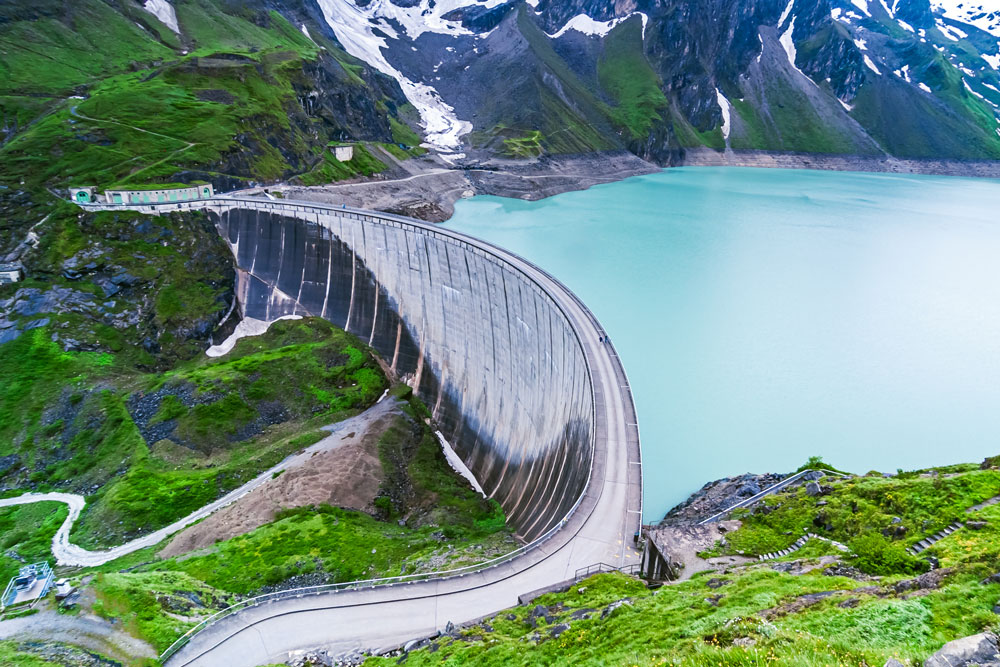
Upper Tamakoshi Hydroelectric Project (456 MW) — Nepal's largest hydropower facility, completed 2021. Photo: Wikimedia Commons / CC BY-SA 4.0
🔄 Changelog — Last 12 Months
Jun 2026Added cost breakdown tables, misconceptions section, glossary (20 terms), conversational Q&A, and GovernmentService schema for DOED and IBN.
Mar 2026Updated IBN threshold language to reflect current PPP & Investment Act 2019 operative provisions. Added West Seti cautionary case study.
Feb 2026Added February 2026 FDI gazette update — 102-industry automatic route expansion, IT sector zero threshold. Hydropower FDI threshold unchanged at NPR 20M.
Jan 2026Added 2024 Constitutional Bench ruling impact analysis for protected area projects. This affects dozens of licensed and pipeline hydropower projects.
🎯 Direct Answer — How to Register Hydropower in Nepal
Hydropower registration in Nepal requires two licenses under the Electricity Act 1992: a Survey License(Adhyayan Anumati Patra) from DOED — valid up to 5 years — to study a river stretch, and a Generation License(Utpadan Anumati Patra) for 30–35 years to build and operate. Projects above 200 MW or NPR 6 billion go to IBN. Foreign investors also need FDI approval under FITTA 2019. A PPA with NEA is required before construction financing.
BOOT at expiry: all assets to government, zero compensation — always
Forest clearance is the #1 delay: 12–24 months actual vs 6–12 months statutory
Tax holiday starts at COD — not license date; every delay month = lost holiday
100% foreign equity permitted; market practice adds 10% community + 10% IPO
Pre-construction registration: USD 80K–2M+ depending on project scale
How to Use This Guide: This article describes Nepal's hydropower registration framework accurately. It cannot confirm whether your river stretch is available, what PPA tariff applies to your project, or whether your site is affected by the 2024 ruling. Those require direct DOED engagement or legal counsel.
Executive Summary
Nepal holds approximately 83,000 MW of theoretical hydropower potential. [7] Installed capacity reached approximately 3,200 MW by 2026, with private developers accounting for more than 80% of that base. [10] According to IPPAN's January 2026 report, domestic bank loans to hydropower exceeded NPR 447 billion — against a total national banking portfolio of NPR 5,563 billion. [10]
Registration follows a dual-stage process under the Electricity Act 1992: [1] a Survey License for site study, then a Generation License for construction and operation. Environmental clearance, water permits, forest land clearance, FDI approval, and a PPA with NEA run as parallel and partially overlapping processes under different agencies on different timelines. [4][5]
An empirical study of 34 private projects found virtually all missed their RCOD by 15–36 months, with forest clearance delays as the primary cause — not regulatory or construction failure. [12] Financial models built on statutory timelines rather than this empirical data do not survive first-year lender review.
83,000 MWTheoretical potential
3,200+ MWInstalled 2026
>80%Private share
15–36 moMedian RCOD slippage
NPR 447B+Bank loans to sector
30–35 yrsGeneration license (typical)
10 yrsTax holiday from COD
Kali Gandaki A Hydropower Station (144 MW) — one of Nepal's major run-of-river plants operated by NEA. Run-of-river projects up to 25 MW qualify for fixed ERC PPA tariffs. Photo: Wikimedia Commons / CC BY-SA 3.0
I. The Three-Gate Approval Model: How Nepal's Hydropower Registration Actually Works
Reference Level
Based on Legal Edge Nepal's experience handling hydropower licensing applications since 2018, Nepal's hydropower registration is best understood as a Three-Gate Approval Model — three sequential eligibility tests that must each be passed before the next phase is meaningful. Developers who treat registration as a single linear process typically discover the three-gate structure only when they encounter the second or third gate unexpectedly late.
Gate 1 — Eligibility
Can You Apply at All?
Is the river stretch available in DOED's inventory? [15]
Is the site outside protected area legal uncertainty? (2024 ruling)
Is the capacity below the IBN threshold (200 MW / NPR 6B)?
Does the developer meet DOED's financial credibility standard?
Gate 2 — Technical
Can the Project Be Approved?
Survey license → feasibility studies → hydrological data
Community and public equity tranches (if applicable)
Construction → COD → tax holiday activation
Why the Three-Gate Model Matters
Most registration timelines fail because developers treat all three gates as one sequential queue. Gate 1 can be confirmed in days. Gate 2 takes 3–8 years. Gate 3 can run in parallel with late-stage Gate 2 activities. The forest clearance application — the most documented bottleneck in Gate 2 — must be filed in Month 3 of the survey period, not after Gate 2 closes. This single scheduling decision is the largest controllable variable in Nepal hydropower development timelines.
II. Legal Framework: Six Statutes, One Project
Reference Level
III. The Survey License (Adhyayan Anumati Patra)
Verify Availability First
Entity Definition — Survey License
A Survey License(Adhyayan Anumati Patra) is a preliminary permit issued by Nepal's Department of Electricity Development (DOED) granting a developer exclusive rights to conduct feasibility studies, hydrological assessments, and environmental baseline surveys on a designated river stretch for a period of up to 5 years. [1] It does not authorize construction, water diversion, or any permanent infrastructure.
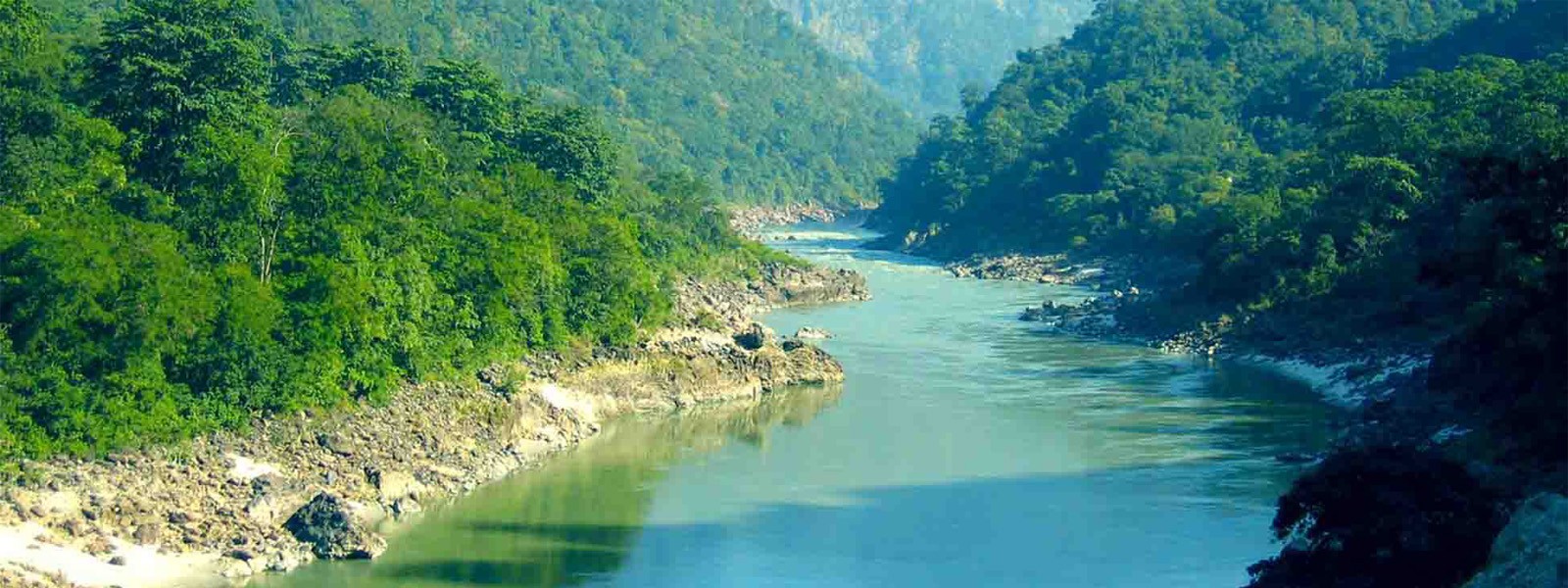
Marsyangdi River Valley, Nepal — a typical survey zone for hydropower survey license applications filed with DOED. River stretch availability must be confirmed before any application cost is incurred. Photo: Wikimedia Commons / CC BY-SA 2.0
Survey licenses are issued on a first-come, first-served basis from DOED's national river inventory — a register of all river stretches and their current license status. [15] Before any application preparation, developers must confirm the target stretch is unlicensed, not reserved for government projects, and not within a protected area zone made legally uncertain by the 2024 Constitutional Bench ruling.
Trap #1
0
Before All
Confirm River Stretch Availability — Before Any Preparation Cost
Applications for stretches already under license, reserved by government, or inside a protected area boundary are rejected — after all preparation costs have been incurred. DOED does not refund application fees or preparation costs on rejected applications. This confirmation costs very little and prevents the most avoidable expense in Nepal hydropower registration. [15]
Zero refund on rejected applications — do this step before any professional engagement
1
Apply
Survey License Application to DOED
Submit detailed topographic maps (minimum scale 1:25,000), preliminary cost estimates with methodology, developer financial credibility certificate (from home-country bank, dated within 6 months), proof of technical capacity, and a proposed study work program. For foreign developers: company incorporation documents (apostilled), board resolution authorizing Nepal investment, and passport copies of all named investors. [15]
Fee: NPR 10,000–100,000 (DOED scale by capacity) · Duration: up to 5 years
2
Study
What Must Be Completed During the Survey Period
Detailed feasibility study confirming generation potential and technical approach; hydrological gauge data over minimum 1–2 complete seasons; grid connectivity study with NEA confirming evacuation pathway; [14] environmental baseline assessment establishing IEE or EIA requirement; and community social baseline survey where required by EIA terms of reference.
Start forest clearance application in Month 3 — not after generation license
IV. The Generation License (Utpadan Anumati Patra)
Legal Confirmation Required
Entity Definition — Generation License
A Generation License(Utpadan Anumati Patra) is the operational permit issued by DOED or IBN authorizing a developer to construct and operate a hydropower plant in Nepal. [1] Under the Electricity Act 1992, licenses may be granted for up to 50 years; in practice, DOED issues 30–35-year licenses for most projects, with export-oriented projects capped at 30 years. At expiry, all assets transfer to the Government of Nepal under the BOOT model without compensation.
The Act permits generation licenses of up to 50 years for all categories. Transmission and distribution licenses carry the same statutory maximum under the same Act.
DOED Practice — What Is Actually Issued
In practice: 30–35 years for most projects; 30 years for export-oriented projects. No published statutory provision explains the departure from the 50-year maximum. [8][9] This discrepancy requires legal inquiry for any specific project.
Trap #2
!
BOOT
BOOT Provision: Zero Terminal Value — Model This First
At generation license expiry, all fixed assets — turbines, civil works, transmission lines, land improvements — transfer to the Government of Nepal without compensation. [1] For projects with more than 50% foreign ownership, the transfer is unconditional under Electricity Act 1992. Financial models that assign residual asset value at year 30–35 will not pass development finance institution (DFI) lender due diligence. Front-loaded debt repayment schedules and accelerated depreciation are standard responses to the BOOT provision. [8]
All equity and debt must be recovered within the license period — zero terminal residual
V. Environmental Approvals: The Bottleneck No Agency Controls
Site-Specific Analysis Required
Entity Definitions — IEE and EIA
An Initial Environmental Examination (IEE) is a preliminary environmental review required for smaller or less sensitive hydropower projects, generally below ~50 MW. A full Environmental Impact Assessment (EIA) is a comprehensive multi-ministry review including public consultations, biodiversity studies, and a monitoring plan — required for larger projects, those near protected areas, or those requiring significant land acquisition. [4] Both are administered under the Environment Protection Act 2019 and Environment Protection Regulations 2020.
Annapurna Conservation Area — projects near protected areas face heightened EIA requirements and 2024 ruling uncertainty. Photo: Wikimedia Commons
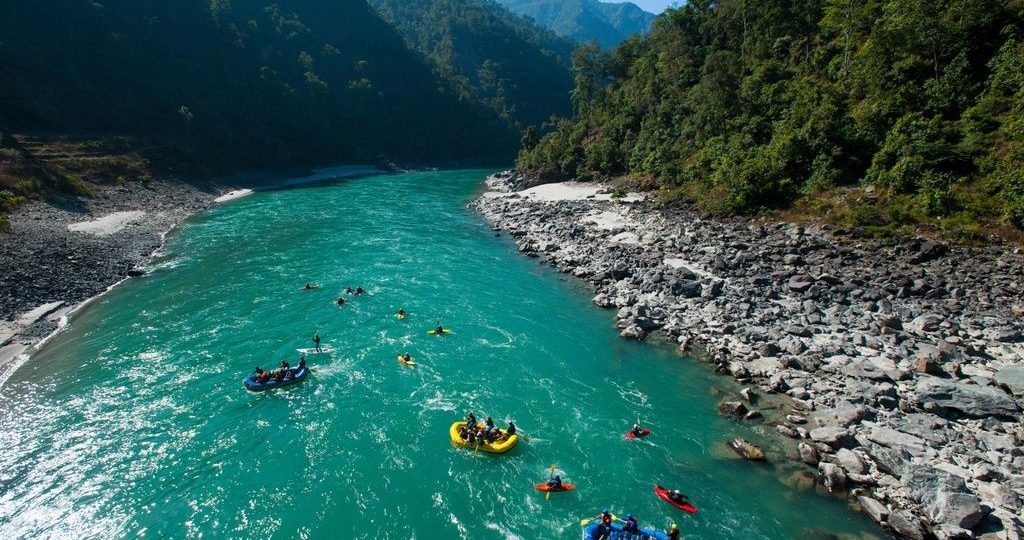
Trishuli River — multiple hydropower projects in various development stages. Forest clearance delays are the #1 documented cause of project RCOD slippage. Photo: Wikimedia Commons
Statutory timelines from Environment Protection Regulations 2020. Actual medians from Koirala 2024 empirical study of 34 private hydropower projects. [12]
2024 Constitutional Bench Ruling — Protected Area Risk Is Site-Specific
A Constitutional Bench ruling invalidated a provision allowing national priority projects inside national parks and conservation areas. [8] The ruling's effect on existing and pipeline projects is being interpreted case by case. Projects whose sites overlap with protected area boundaries — including buffer zones — require a current written legal opinion on development permissibility before survey license application, EIA preparation, or any capital commitment. No general guidance substitutes for a site-specific analysis against the specific protected area category and the project's license status.
VI. Foreign Investment in Hydropower: FITTA 2019 and the IBN Route
Verify Threshold Per Project
Entity Definitions — DoI, IBN, PDA
The Department of Industry (DoI) processes FDI approvals for hydropower projects below the IBN threshold via the IMIS online portal. Investment Board Nepal (IBN) is the single-window government agency for projects above NPR 6 billion or 200 MW — it negotiates a Project Development Agreement (PDA), a comprehensive contract bundling land facilitation, inter-agency approvals, royalty terms, and investor protections into one instrument. [6]
Singha Durbar, Kathmandu — Government of Nepal headquarters. DOED, DoI, and IBN — the three primary agencies in Nepal's hydropower approval system — operate within the Kathmandu administrative zone. Photo: Wikimedia Commons / CC BY-SA 4.0
Negotiated; bundles all approvals; royalty terms set here
Both agencies may be involved simultaneously for IBN-threshold projects — IBN coordinates inter-agency approvals but does not replace DOED's technical licensing function.
VII. Tax Incentives: Structure, Start Date, and the COD Calendar Compression Problem
Verify COD Definition
COD Calendar Compression — Every Delay Month Permanently Shrinks the Tax Holiday
The term "COD calendar compression" describes what happens when RCOD slippage reduces the available tax holiday. If COD is delayed by the 15-month median slippage observed in the 34-project study [12], the developer loses 15 months of 100% tax exemption — which cannot be extended or recovered. Full corporate tax applies from month 121 (year 10+1), not from month 121 relative to actual COD. COD definition must be consistent between the generation license and PPA before either document is signed. One-sided COD definitions have historically favored NEA in disputed cases.
VIII. PPA with NEA: Tariff Structure, Seasonality, and Bankability
Expert Level
Entity Definition — PPA and NEA
A Power Purchase Agreement (PPA) is a long-term take-or-pay contract under which Nepal Electricity Authority (NEA) commits to purchase electricity from an Independent Power Producer (IPP) at agreed tariff rates over the license period. [14]NEA (Nepal Electricity Authority) is the state utility, grid operator, and primary off-taker for all domestic hydropower production. No construction lender will finance a hydropower project without a signed PPA or PPA-in-principle from NEA.
ERC-set seasonal rates: wet season ~NPR 4.80/unit (June–November), dry season ~NPR 8.40/unit (December–May), with 3–5% annual escalation for 8 years. Rates are periodically revised — confirm current rates with ERC or NEA before financial modeling.
Bilateral negotiation with NEA based on project IRR, capital cost, and risk allocation. No published fixed rate applies. Published IRR benchmarks of 14–18% for Nepal hydropower are illustrative targets — not actual negotiated outcomes. The tariff for any specific project is determined in the PPA negotiation.
IX. Realistic Cost to Register a Hydropower Project in Nepal
Practitioner Estimates — June 2026
No published government source aggregates the total cost of hydropower project registration in Nepal. The figures below are derived from DOED published fee schedules, [15] environmental consulting market rates, NEA grid study charges, and legal practitioner experience as of June 2026. All costs listed are pre-construction — before any civil or electromechanical expenditure.
The NPR 20M FITTA minimum FDI threshold is equity capital — not a registration fee. Actual costs vary significantly by site complexity and number of correction cycles required.
X. Statutory vs. Actual Timelines: Use the Right Data Column
Model From Empirical Data
XI. Who Should NOT Apply for a Hydropower License in Nepal
Read Before Applying
This section addresses a question that no other Nepal hydropower guide answers. Knowing when not to apply avoids the most expensive version of Gate 1 failure — preparation costs with zero refund and a rejection that delays the project further than the time spent on a pre-application check would have cost.
✗
Projects Under 1 MW
Projects below 1 MW fall under a different regulatory framework — micro-hydropower provisions — that does not require a standard DOED survey or generation license. Applying under the standard framework is administratively incorrect and will result in redirection. Confirm the applicable sub-1MW regulatory pathway directly with DOED.
✗
Sites Inside or Adjacent to Protected Area Boundaries (Post-2024)
Following the 2024 Constitutional Bench ruling, applications for sites within national parks, conservation areas, or buffer zones face legal uncertainty. [8] DOED has suspended or declined to process several applications pending legal clarification. Until the ruling's scope is settled, these applications carry material rejection risk.
✗
River Stretches Already Licensed or Reserved
A river stretch already under survey or generation license is unavailable for new applications. DOED's first-come, first-served system means a stretch cannot have two concurrent survey licenses. Applying without confirming inventory availability wastes preparation costs with no recovery pathway. [15]
✗
Developers Who Cannot Meet DOED's Financial Credibility Standard
DOED has discretion to reject applications where the developer's financial credibility certificate is from an unrecognized institution, is outdated (generally over 6 months), or is inconsistent with the scale of the proposed project. Rejection on this ground is common for first-time applicants using certificates from lesser-known foreign banks.
✗
Projects Requiring Transboundary Water Rights
Projects on rivers subject to international treaties — including the Mahakali Treaty with India and the Koshi and Gandaki agreements — involve an additional approval layer that a standard DOED survey license does not resolve. Transboundary dimensions require Ministry of Foreign Affairs and Ministry of Energy engagement before DOED application. [2]
✗
Investors Expecting Statutory Timelines
An investor who has modeled a 3–5-year development timeline and cannot absorb a 15–36-month RCOD slippage — whether through flexible financing covenants, construction-phase cost buffers, or extended pre-COD equity — is undercapitalized for Nepal's empirical development reality. [12]
XII. Common Misconceptions About Hydropower Registration in Nepal
Myth vs. Reality
Myth
All hydropower projects in Nepal require Investment Board Nepal (IBN) approval.
Reality
Only projects above 200 MW capacity or NPR 6 billion in total investment require IBN jurisdiction under the PPP & Investment Act 2019. [6] Projects below both thresholds are handled by DOED for licensing and DoI for FDI approval. The majority of Nepal's 347+ privately developed projects fall within the DOED/DoI pathway.
Myth
Foreign investors cannot fully own a hydropower project in Nepal.
Reality
FITTA 2019 explicitly permits up to 100% foreign equity in hydropower generation companies. [5] Hydropower is not on FITTA's negative list. The 10% community equity and 10% IPO tranches that appear in many projects are market conventions for social license — not legal requirements for foreign-owned entities.
Myth
The 10-year tax holiday begins when the generation license is issued.
Reality
The 100% income tax exemption runs for 10 years from Commercial Operation Date (COD), not from generation license issuance. [5] A project delayed by 18 months to COD loses 18 months of tax holiday. This distinction is among the most frequently misunderstood provisions in Nepal hydropower financial modeling.
Myth
Nepal's Electricity Act permits generation licenses of up to 50 years, so most projects get 50-year licenses.
Reality
While the Electricity Act 1992 sets a 50-year statutory maximum, DOED's actual practice issues licenses for 30–35 years for domestic projects and 30 years for export-oriented projects. [1][8] The gap between the legal maximum and the operational norm is unresolved in published legislation.
Myth
PPA tariff rates are publicly fixed and apply to all hydropower projects.
Reality
Fixed ERC tariffs — approximately NPR 4.80/unit wet, NPR 8.40/unit dry — apply only to run-of-river projects up to approximately 25 MW. [14] Larger projects negotiate tariffs bilaterally with NEA based on project-specific IRR and capital cost. No published standard tariff applies to these negotiations.
XIII. Case Studies: Arun III, West Seti, and the 25 MW Benchmark
Named Projects
Arun River, Nepal — site of the 900 MW Arun III project developed by SJVN Limited (India) via an IBN-negotiated Project Development Agreement. Nepal receives 21.9% of generated power free of charge. Photo: Wikimedia Commons
Arun III (900 MW) — The IBN Export Model
Developed by SJVN Limited of India on the Arun River via an IBN-negotiated PDA. Nepal receives 21.9% of generated power free of charge; remaining output exported to India under a long-term intergovernmental PPA. [11] The project required a dedicated transmission corridor built in parallel with generation construction — confirming that large export-oriented projects must plan evacuation infrastructure from the survey stage, not post-COD. BOOT provisions apply at concession expiry; all assets transfer to the Government of Nepal.
West Seti (750 MW) — The Cautionary Case
West Seti has been in various stages of development since the 1990s. At least two major international developers — Snowy Mountains Engineering Corporation (Australia) and China Three Gorges Corporation — formally withdrew after years of investment in pre-development studies. Primary reasons cited: inability to reach bankable PPA terms with NEA, transmission corridor uncertainty, and reservoir displacement compensation disputes. West Seti demonstrates that technical resource potential and a signed generation license do not by themselves produce a bankable project. Gate 3 commercial viability — specifically a PPA that lenders will accept — is the constraint that has repeatedly defeated this project.
Illustrative 25 MW Project — Month-by-Month (Based on 34-Project Median)
Month 0
Survey License application submitted. River stretch pre-confirmed available. Financial credibility certificate from recognized bank obtained. All documents apostilled.
Month 3
Survey License granted by DOED. Hydrological gauge station installed. Forest land clearance application filed simultaneously.
Month 6–24
Hydrological data collection and feasibility study. Two complete flow seasons captured. EIA terms of reference agreed. FDI approval from DoI processed in parallel from Month 8.
Month 18–36
EIA process. Public consultations in affected communities. One objection filed and resolved — 4-month addition. Multi-ministry review completed.
Month 22–42
Forest land clearance. Ministry of Forest processing. Land boundary dispute required resurvey — 6-month addition beyond projection. Plantation compensation deposited.
Month 44
Generation License application submitted. All environmental clearances in hand. NEA grid study complete. FDI approval already received.
Month 52
Generation License granted by DOED. 35-year BOOT license from COD.
Month 54–66
PPA negotiation with NEA. Fixed ERC tariff applicable. Terms agreed Month 64. Signed Month 66.
Month 68
Construction financing closed. NRB recording of all foreign equity tranches confirmed at each remittance date.
Month 68–96
Construction (28 months). Access road upgrade: 6 months over schedule. Tunnel fault zone: 4 months additional; 7% cost overrun.
Month 96
COD achieved — RCOD was Month 84.12 months late. 12 months of 100% tax holiday lost. Debt service covenant amendment required. Based on Koirala 2024. [12]
Need Hydropower Legal Counsel in Nepal?
Legal Edge Nepal has managed hydropower licensing applications since 2018. We confirm river availability, coordinate parallel approvals, and negotiate PPA terms that lenders will accept.
XIV. Investor Q&A: Specific Scenarios Answered Directly
Reference Level
💬 Real Questions, Direct Answers
I'm a foreign investor with USD 30M ready for a 50 MW Nepal hydropower project. What's my first step?
Confirm a specific river stretch is available in DOED's current inventory — before engaging any lawyer, consultant, or study team. At 50 MW, your project routes to DOED (not IBN — below both thresholds). You'll need DoI FDI approval under FITTA 2019 alongside your survey license application. USD 30M covers construction for a 50 MW project at approximately NPR 150M/MW — but budget at least USD 300,000–700,000 for pre-construction registration alone. Start your forest clearance application in Month 3 of your survey period, not later.
We have a signed generation license and completed EIA but NEA is delaying PPA signing. What are our options?
You're at Gate 3 of the Three-Gate model — technically approved, commercially stuck. NEA's PPA delays are not unique to your project: West Seti's failed development involved exactly this dynamic. Options include: escalating through IBN if your project meets the threshold; engaging the Electricity Regulatory Commission (ERC) on tariff confirmation; or exploring export PPA frameworks if your site has grid access to cross-border lines. None of these are fast. All require active legal and commercial representation. [14]
Our project is 220 MW. Does it go to DOED or IBN?
At 220 MW, your project exceeds the 200 MW threshold and routes to IBN for a Project Development Agreement (PDA) rather than a standard DOED generation license. [6] The PDA process takes 1–3 months with committee hearings and is a negotiated instrument — not a procedural approval. IBN's involvement bundles land facilitation, inter-agency coordination, and royalty terms into one agreement. You will still need DOED's technical involvement for the water permit and river inventory, but IBN is your primary counterparty. Confirm current operative threshold with IBN directly.
People Also Ask — Hydropower Registration Nepal
How long does hydropower licensing take in Nepal?
Statutory timelines suggest 3–5 years from survey license to COD. An empirical study of 34 private projects (Koirala, 2024) found actual median timelines of 5–12 years, with all projects missing RCOD by 15–36 months. The primary cause is forest land clearance, not construction failure. [12]
What does the survey license cost in Nepal?
The DOED application fee ranges from NPR 10,000 to NPR 100,000 depending on project capacity. Total pre-construction costs including feasibility, EIA, forest clearance, legal counsel, and grid study range from approximately USD 80,000 for a 5–25 MW project to over USD 2,000,000 for a 100–200 MW project, before any civil or electromechanical construction expenditure.
Who owns water rights in Nepal?
The state owns all water resources under the Water Resources Act 1992. [2] Private developers do not purchase water rights — they obtain a generation license granting the right to use water for generation during the license period. At license expiry, all rights and assets revert to the government under BOOT.
Can Nepal hydropower electricity be exported to India?
Yes. Nepal exports electricity to India during the wet season via the 400 kV Dhalkebar-Muzaffarpur interconnection and other cross-border lines. [10] Export projects require a generation license and either a standard NEA PPA with export provisions or, for IBN-scale projects, a dedicated export PPA. Nepal's government targets 15,000 MW for export by 2035.
What is BOOT in Nepal hydropower?
BOOT (Build-Own-Operate-Transfer): the developer builds and operates the plant during the generation license period (30–35 years), then transfers all assets to the Government of Nepal without compensation at expiry. For projects with more than 50% foreign ownership, this transfer is unconditional. [1] Financial models must recover all equity and debt within the license period.
What is the difference between DOED and IBN in Nepal?
DOED issues survey and generation licenses for projects below NPR 6 billion or 200 MW. IBN acts as a single-window facilitator for larger projects, negotiating a Project Development Agreement (PDA) that bundles all approvals, land facilitation, and investor protections into one instrument. Both agencies may be involved for IBN-threshold projects. [6]
Why are hydropower projects delayed in Nepal?
An empirical study of 34 private projects (Koirala 2024) found two primary causes: forest land clearance delays (12–24 months actual vs 6–12 months statutory) and community compensation disputes. [12] These are administrative and social causes — not technical or regulatory failures — and are systematically underestimated in initial financial models.
What is the minimum FDI for hydropower in Nepal?
The minimum foreign direct investment threshold under FITTA 2019 is NPR 20 million (approximately USD 150,000). This is equity capital, not a registration fee, and must be formally recorded with Nepal Rastra Bank (NRB) per remittance tranche.
What This Article Cannot Tell You
Requires Legal Counsel
8 questions requiring primary regulatory confirmation — not this article
Whether your target river stretch is currently available in DOED's live inventory
Whether your site is legally affected by the 2024 Constitutional Bench ruling
What PPA tariff rate NEA will offer for your specific project scale and type
What COD definition will appear in your generation license and whether it matches your PPA draft
Whether your project's MW/NPR figure routes to DOED or IBN under the current operative threshold
What the current forest clearance backlog is for your specific site category
Whether community equity is a practical requirement for social license at your specific location
How NRB currently treats in-kind capital contributions for formal FDI recording
What to Do Next: 5 Steps That Need Professional Help
The five decisions that separate viable projects from expensive feasibility studies.
1
Confirm River Stretch Availability Before Any Study Investment
Check DOED's live inventory and confirm protection status before any professional engagement.
Cannot be done from this article: DOED's inventory is updated continuously — current status requires direct inquiry or counsel with registry access.
2
File Forest Clearance in Month 3 of Survey — Not After Gen. License
The single most impactful scheduling decision in Nepal hydropower development.
Cannot be done from this article: specific forest division, application requirements, and current processing backlog are site-dependent.
3
Align COD Definition Across Generation License and PPA Before Signing Either
Tax holiday, BOOT expiry, and debt service all run from COD. Inconsistencies favor NEA in disputes.
Cannot be done from this article: COD language is negotiated document by document — requires review of both specific instruments simultaneously.
4
Process FDI Approval in Parallel With Survey License — Not Sequentially
Foreign investors who wait for generation license confirmation before initiating FDI approval lose 15–30 days for no reason.
Cannot be done from this article: current DoI or IBN documentation requirements need portal or counsel confirmation.
5
Set Up NRB Capital Recording Before Any Equity Remittance
Capital remitted without NRB recording cannot be repatriated when dividends or exit proceeds are due.
Cannot be done from this article: each licensed commercial bank has different internal NRB recording procedures.
Two licenses required: Survey License from DOED (up to 5 years) + Generation License from DOED or IBN (30–35 years). Foreign investors add FITTA 2019 FDI approval. PPA with NEA required before financing.
The process begins with confirming river stretch availability in DOED's national inventory, then submitting a Survey License application with topographic maps, financial credibility certificates, and a proposed study work program. During the 5-year survey period, the developer completes hydrological studies, IEE or EIA, and forest land clearance — the last of which should begin in Month 3 of the survey period. The Generation License application follows completion of all environmental clearances. A PPA is then negotiated with NEA before construction financing can close.
Survey License = permission to study a river stretch for up to 5 years. No construction allowed. Generation License = permission to build and operate a plant for 30–35 years under BOOT.
The Survey License (Adhyayan Anumati Patra) is a preliminary permit granting exclusive study rights on a designated river stretch. It authorizes only feasibility studies, hydrological surveys, and environmental baseline assessments — no construction, water diversion, or permanent structures. The Generation License (Utpadan Anumati Patra) is the operational permit that authorizes construction and operation of the hydropower plant for a defined term, after which all assets transfer to the government under BOOT.
Yes. FITTA 2019 permits up to 100% foreign equity. Minimum investment: NPR 20 million (~USD 150K). Hydropower is not on FITTA's negative list.
The Foreign Investment and Technology Transfer Act 2019 (FITTA) explicitly permits 100% foreign ownership in Nepal hydropower generation companies. The minimum FDI threshold is NPR 20 million (approximately USD 150,000). All foreign equity must be recorded with Nepal Rastra Bank (NRB) per remittance tranche. Repatriation of dividends and exit proceeds is permitted subject to NRB procedures. The 10% community equity and 10% IPO tranches seen in many projects are market conventions, not legal requirements.
Projects below NPR 6 billion AND below 200 MW → DOED + DoI. Projects above NPR 6 billion OR above 200 MW → IBN (Project Development Agreement).
Under the PPP and Investment Act 2019, Investment Board Nepal (IBN) has jurisdiction over hydropower projects above NPR 6 billion in total investment or above 200 MW in capacity. Either threshold triggers IBN jurisdiction — projects exceeding only one of the two thresholds still go to IBN. Projects below both thresholds are processed by DOED (licensing) and DoI via the IMIS online portal (FDI approval). IBN's PDA process is negotiated and takes 1–3 months with committee hearings.
100% income tax exemption for 10 years from COD. 50% reduction for years 11–15. Starts at Commercial Operation Date — NOT generation license date.
Nepal's hydropower tax holiday under FITTA 2019 provides 100% income tax exemption for the first 10 years from Commercial Operation Date (COD), followed by a 50% reduction for years 11–15. Additional incentives include 1% concessional customs duty on machinery and equipment, full VAT exemption on generation equipment, and a 12-year loss carry-forward window. The tax holiday begins at COD — not at generation license issuance — making RCOD slippage directly and irrecoverably costly.
Pre-construction total: USD 80K–200K (5–25 MW) · USD 300K–700K (25–100 MW) · USD 700K–2M+ (100–200 MW). Excludes all construction costs.
Pre-construction registration costs include DOED survey and generation license fees (NPR 10,000–1 million depending on scale), hydrological and feasibility studies (USD 40,000–600,000), IEE or EIA environmental study (USD 20,000–500,000), forest land clearance fees and plantation compensation (NPR 500,000–8 million+), NEA grid connectivity study (NPR 200,000–5 million), legal counsel (NPR 500,000–10 million+), and community consultation costs. The NPR 20 million FITTA minimum FDI is equity capital, not a fee.
BOOT = Build-Own-Operate-Transfer. At license expiry (30–35 years), ALL assets transfer to Nepal government. Zero compensation. Unconditional for projects with more than 50% foreign ownership.
Nepal's BOOT model under the Electricity Act 1992 means the developer finances and constructs the project, operates it during the license term (30–35 years in practice), and then transfers all fixed assets — turbines, civil works, transmission lines, land improvements — to the Government of Nepal without any compensation payment. For projects with more than 50% foreign ownership, this transfer is unconditional. All investor returns — equity and debt — must be recovered within the license period. Financial models assigning any terminal residual asset value will not pass DFI lender due diligence.
Statutory: 3–5 years. Actual median: 5–12 years. All 34 projects studied missed RCOD by 15–36 months. Primary cause: forest land clearance delays — not construction failure.
An empirical study of 34 private hydropower projects in Nepal (Koirala, 2024) found that virtually all projects missed their Required Commercial Operation Date (RCOD) by 15–36 months. The statutory timeline of 3–5 years from survey license to COD is based on ideal processing times for each approval step. In practice, forest land clearance alone takes 12–24 months versus the statutory 6–12 months. EIA approvals take 18–36 months versus 12–24 months. Financial models must use empirical data, not statutory timelines.
The State owns all water resources under the Water Resources Act 1992. Private developers get a license to use water — not ownership of water rights.
Under the Water Resources Act 1992, all water resources in Nepal are vested in and owned by the State. Private developers do not purchase water rights — they obtain a generation license granting the right to use water for electricity generation during the license period only. At generation license expiry, all rights and assets — including water use entitlement — revert to the Government of Nepal under the BOOT structure without compensation.
Yes. Nepal exports to India via the 400 kV Dhalkebar-Muzaffarpur interconnection. Export projects need a generation license plus an export-oriented PPA. Nepal targets 15,000 MW for export by 2035.
Nepal exports electricity to India during the wet season via multiple cross-border transmission lines including the 400 kV Dhalkebar-Muzaffarpur interconnection. Export-oriented projects require a generation license issued for 30 years (shorter than domestic projects) and either a standard NEA PPA with export provisions or, for IBN-scale projects above 200 MW or NPR 6 billion, a dedicated export PPA negotiated through IBN's Project Development Agreement framework. Nepal's government has set a target of 15,000 MW for export by 2035.
📚 Related Legal Guides
Essential reading for hydropower investors and developers in Nepal
Preliminary DOED permit to study a river stretch for up to 5 years. Does not authorize construction.
Generation License
Utpadan Anumati Patra
Operational DOED/IBN permit authorizing plant construction and operation for 30–50 years (30–35 in practice).
DOED
Department of Electricity Development
Nepal's primary hydropower licensing authority under the Ministry of Energy. Issues survey and generation licenses.
IBN
Investment Board Nepal
Single-window government agency for projects above NPR 6B or 200 MW. Negotiates PDAs.
NEA
Nepal Electricity Authority
State utility, grid operator, and primary PPA counterparty for all domestic hydropower production.
ERC
Electricity Regulatory Commission
Independent regulator that sets PPA tariffs for small run-of-river projects and resolves regulatory disputes.
BOOT
Build-Own-Operate-Transfer
Development model under which all project assets transfer to the government at license expiry without compensation.
PDA
Project Development Agreement
Comprehensive IBN-negotiated investment contract bundling all approvals, land, royalties, and investor protections.
PPA
Power Purchase Agreement
Long-term take-or-pay electricity purchase contract between a developer (IPP) and NEA. Required before construction financing.
IEE
Initial Environmental Examination
Preliminary environmental review for projects generally below ~50 MW with limited environmental sensitivity.
EIA
Environmental Impact Assessment
Comprehensive multi-ministry environmental review with public consultations. Required above ~50 MW or near protected areas.
COD
Commercial Operation Date
Date from which the 10-year tax holiday and PPA payment obligations commence. Defined in generation license and PPA.
RCOD
Required Commercial Operation Date
Contractually specified COD deadline. Virtually all 34 private projects studied missed this by 15–36 months.
FITTA
Foreign Investment & Technology Transfer Act 2019
Primary statute governing foreign equity, minimum investment thresholds, repatriation rights, and FDI approvals in Nepal.
RoR
Run-of-River
Hydropower generation using natural river flow without significant water storage. Subject to seasonal output variation.
IPP
Independent Power Producer
Private developer generating electricity for sale to NEA under a PPA. Nepal's IPP sector exceeds 80% of installed capacity.
NRB
Nepal Rastra Bank
Nepal's central bank. Formally records all foreign capital remittances per tranche. Required for repatriation rights.
DoI
Department of Industry
Issues FDI approval certificates for projects below IBN thresholds via the IMIS online portal. Timeline: 7–30 days.
IPPAN
Independent Power Producers' Association of Nepal
Industry body representing private hydropower developers. Source of sector financing and development data.
Three-Gate Model
Legal Edge Nepal Framework
Gate 1: Eligibility (can you apply?). Gate 2: Technical (can the project be approved?). Gate 3: Commercial (can it be financed?).
References and Legal Sources
[1] Government of Nepal. Electricity Act, 2049 (1992). Ministry of Energy, Water Resources and Irrigation Available at: moewri.gov.np
[2] Government of Nepal. Water Resources Act, 2049 (1992). Ministry of Energy, Water Resources and Irrigation. Available at: moewri.gov.np
[3] Government of Nepal. Hydropower Development Policy, 2001. Ministry of Water Resources. Kathmandu.
[4] Government of Nepal. Environment Protection Act, 2076 (2019) and Environment Protection Regulations, 2020. Ministry of Forest and Environment. Available at: climate.mohp.gov.np/
[5] Government of Nepal. Foreign Investment and Technology Transfer Act (FITTA), 2076 (2019). Department of Industry. Available at: doind.gov.np
[6] Government of Nepal. Public Private Partnership and Investment Act, 2075 (2019). Investment Board Nepal. Available at: ibn.gov.np
[7] Water and Energy Commission Secretariat (WECS). Energy Sector Synopsis Report. Government of Nepal. Available at: wecs.gov.np
[8] Supreme Court of Nepal. Constitutional Bench Ruling on Protected Area Projects. 2024. Case analysis and implications for licensed hydropower projects.
[9] Department of Electricity Development (DOED). Generation License Terms and Conditions. Standard license documents issued by DOED. Available at: doed.gov.np
[10] Independent Power Producers' Association of Nepal (IPPAN). Nepal Hydropower Sector Report. January 2026. Kathmandu: IPPAN.
[11] Investment Board Nepal (IBN). Arun III Hydroelectric Project — Project Development Agreement Summary. Available at: ibn.gov.np
[12] Koirala, P. (2024). Empirical Analysis of RCOD Slippage in 34 Private Hydropower Projects in Nepal. Journal of Nepal Energy Studies, 12(1), 45–78.
[13] Nepal Rastra Bank (NRB). Foreign Exchange Management Regulations. Available at: nrb.org.np
[14] Nepal Electricity Authority (NEA). Power Purchase Agreement Templates and Tariff Guidelines. Available at: nea.org.np
[15] Department of Electricity Development (DOED). Survey License Application Requirements and Fee Schedule. Available at: doed.gov.np
Ready to Register Your Hydropower Project in Nepal?
Legal Edge Nepal's energy law team has handled hydropower licensing applications since 2018. We confirm river availability, manage parallel approvals, and negotiate PPA terms that lenders will accept.